

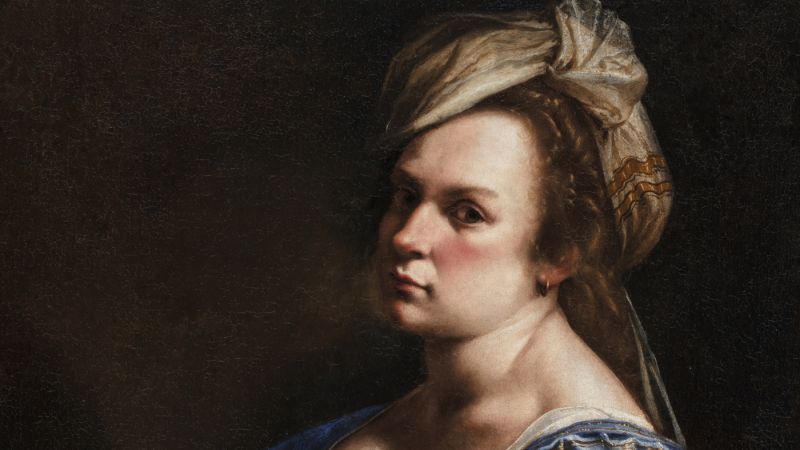
Artemisia Gentileschi was a pioneering and fearless Roman artist whose trailblazing artistic legacy is only being fully appreciated in modern times.
The stellar career of Italian early baroque painter Artemisia Gentileschi has long been overshadowed by her tumultuous life story, whose tragedies and triumphs continue to captivate the public imagination more than three and a half centuries after her death.
Born in Rome in 1593, Gentileschi was the eldest of five children, and only daughter of Orazio to whom she was apprenticed in her early teens following the death of her mother.
In 1610, aged 17, she made her stunning debut with Susanna and the Elders. Her use of a full-frontal nude to interpret a biblical tale was particularly daring during the Counter-Reformation era. The fact that this masterpiece was painted by a female, a teenager at that, during a time when women artists were confined to portraits and still lifes, was even more mould-breaking.
Detail of Susanna and the Elders by Artemisia Gentileschi
The Rome of Gentileschi’s childhood was plagued by violence and crime, meaning she had little access to the city’s cultural heritage and its hive of artistic production.
The year after she painted Susanna and the Elders, Gentileschi began taking private lessons from her father’s artist colleague Agostino Tassi, who raped the teenager in her own bedroom. Nine months later Orazio took Tassi to court for reneging on his alleged promise to marry his daughter to “restore her dignity”.
The 18-year-old Gentileschi’s trauma was compounded by a gruelling seven-month public trial in which she testified courageously against her perpetrator, a despicable character whose murky past included accusations of raping his sister-in-law and having his wife murdered by bandits.
As part of then courtroom practice Gentileschi was subjected to sibille, a primitive mediaeval torture device involving the tightening of thumbscrews or metal rings around her fingers, to ensure she was telling the truth, leading her to shout across the courtroom to Tassi: “This is the ring and these the promises you gave me.”
The trial in 1612 and its salacious details shocked Rome and received considerable publicity. A transcipt from the court still survives, providing a graphic account of the case which propelled the young Gentileschi into the spotlight for the worst reasons. Paradoxically it was the victim who suffered the worst punishment in the end: although Tassi was found guilty of rape and was imprisoned for two years, his verdict was later annulled and he was at liberty a year later.
Following the trial, Gentileschi was forced into a rushed arranged marriage with the cash-strapped Florentine artist Pierantonio di Vicenzo Stiattesi. Exiled to Florence in 1613, Gentileschi’s personal situation was worsened by a loveless union and the premature deaths of several children. However she countered this litany of misfortune with tenacity and talent, becoming the first woman accepted to the Accademia del Disegno.
Florence also allowed Gentileschi to meet other artists of the day, such as Cristofano Allori who introduced her to influential figures including Cosimo II de’ Medici, Grand Duke of Tuscany, while her patron Michelangelo Buonarroti the Younger helped her win prestigious commissions and acquainted her with the scientist Galileo.
In 1620 Gentileschi returned to Rome with her husband, her daughter Palmira and her lover Francesco Maria Maringhi, who helped her keep two homes on Via del Corso and Via della Croce. Despite the seemingly violent relationship with her father, she was now free to explore the capital as well as interact with her artist peers, notably French painter Simon Vouet, who was so impressed with her work that he painted her portrait, palette in hand.
During her time in Rome Gentileschi’s prowess as a portrait painter continued to develop, as she absorbed the influences of artists working round her. In 1630 Gentileschi moved to Naples, making her Neapolitan debut with the celebrated Annunciation, influenced stylistically by Massimo Stanzione, who was working in the city at the time.
Detail of Self-portrait as the Allegory of Painting by Artemisia Gentileschi
In 1638 Gentileschi travelled to London, apparently at the invitation of Charles I, where she joined her ailing father at the Stuart court. She worked closely with him on paintings for the ceiling at the Queen’s House, as well as undertaking numerous other works before his death in 1639, while remaining in England for a further year or two to fulfil her commissions.
Most of her London works were dispersed in the sale of crown assets after Charles was beheaded in 1649 and her only identifiable work still in the Royal Collection today is Self-portrait as the Allegory of Painting.
Little is known of her movements after her eventual return to Italy. Records indicate that Gentileschi worked in Naples until her death, the exact date of which is unknown but is believed to have been in or around 1656.
Much like Caravaggio, Gentileschi was largely forgotten until the 20th century. Renewed interest in her work was sparked in 1916 when a research paper by Italian art critic Roberto Longhi described Gentileschi as “the only woman in Italy who ever knew about painting, colouring, doughing, and other fundamentals”. Interest grew further in 1947 following the publication of Artemisia, a fictional account of Gentileschi’s life by Longhi’s wife, Anna Banti.
Mary Magdalene in Ecstasy by Artemisia Gentileschi
Gentileschi expert Judith Mann describes it as a “phenomenon in the history of art that we understood the artist’s life far earlier than her painting.”Despite a growing appreciation for the artist’s work, the gender gap on the art market between father and daughter Gentileschi remains substantial. In January 2016 the painting Danae by Orazio was bought at auction in New York by the Getty Museum in Los Angeles for more than $30 million. Two years earlier, Mary Magdalene in Ecstasy by Artemisia was sold at auction in Paris for €865,000.
Notwithstanding the widely-held narrative that the rape of a teenage Gentileschi had an everlasting effect on her artistic output – leading to her reputation as a painter of powerful women as well as her modern-day interpretation as a feminist heroine – the artist will be forever remembered for her masterful artistic legacy and for ‘shattering the glass ceiling’ in a male-dominated age.
By Andy Devane
