

From Canterbury to the Vatican, the Ancient Path of Kings, Popes and Ordinary Pilgrims Remains One of Europe’s Most Transformative Journeys.
The Via Francigena is not the Camino de Santiago. This is the first thing to understand about it, and perhaps the most important. Both are ancient pilgrimage routes. Both wind through spectacular European landscapes. Both have experienced a renaissance in recent years as people seek to slow down, disconnect from screens, and reconnect with something older than themselves. But where the Camino de Santiago leads to the tomb of an apostle in northwestern Spain, the Via Francigena leads to the tomb of the Prince of Apostles himself, buried beneath the Basilica of St. Peter in Rome.
The distinction matters. The Camino is a journey of spiritual seeking. The Via Francigena is a journey of arrival at the centre of Catholic Christianity. One is about the road. The other is about the destination, and what happens when you finally get there.
What It Is
The Via Francigena, known in English as the Way of St. Francis or the Frankish Way, is a network of pilgrimage routes that converge on Rome from across northern Europe. The routes are not a single path but multiple branches that eventually join together as they approach the Italian peninsula. Some pilgrims begin in Canterbury, England. Others start in Paris, or further north in Belgium and the Netherlands. The most common modern starting point is in the Alps; either at Mont Cenis, at the border between France and Italy, or at the Great St. Bernard Pass between Switzerland and Italy.
What makes the Via Francigena distinct from other European pilgrimage routes is its antiquity and its papal origin. Unlike the Camino, which developed gradually over centuries after the discovery of St. James’s tomb, the Via Francigena was formally established and encouraged by the papacy itself. In 990 AD, Archbishop Sigeric of Canterbury made a pilgrimage to Rome and documented the route in detail. His account, preserved in the Canterbury Archives, forms the basis of what modern pilgrims follow today.
The History
The roots of the Via Francigena run deep. Pilgrims began walking to Rome to visit the tombs of St. Peter and St. Paul almost immediately after their deaths in the first century. During the medieval period, as the papacy’s power grew, so did the flow of pilgrims. Kings and emperors walked the route. Popes blessed it. Monasteries and hospices were established along the way, funded by the Church and by nobles seeking spiritual merit.
By the medieval period, the three great pilgrimage destinations in Christianity were Jerusalem (the Holy Land), Santiago de Compostela (Spain), and Rome. The Via Francigena served those who could not reach Jerusalem due to the Crusades and who had not committed to the longer Spanish route. For centuries, it was Europe’s second-most important pilgrimage.
The route fell into disuse during the Renaissance and Reformation, as religious practice shifted and travel became faster and less spiritual. For nearly 500 years, the Via Francigena was largely abandoned, known only to a few historians and pilgrims maintaining a handful of stretches in isolated regions.
That changed in the 1990s. The European Union designated it as one of the Council of Europe’s Cultural Routes. Italy began to mark and maintain the paths. Modern pilgrims, inspired by the success of the Camino revival, began rediscovering the route. Today, thousands of people walk segments of the Via Francigena annually, though it remains far less crowded than the Spanish route.
The Routes
The Via Francigena is not a single path but a network. The two main northern European branches are:
The northern route begins in Canterbury, England, and winds through France via Reims, Troyes and the Burgundy wine region. It crosses into Switzerland and descends toward Italy.
The eastern route starts in Belgium or the Netherlands and passes through Cologne, Frankfurt, and the Rhine valley before turning south into Switzerland.
Both converge near the Great St. Bernard Pass or Mont Cenis in the Alps, then descend into Italy through the Val d’Aosta or Piedmont. From there, they merge into a single route that passes through Ivrea, Vercelli, Piacenza and Tuscany before reaching Rome.
The Italian Stretch: What to See
For most modern pilgrims, the Via Francigena in Italy is the portion that matters most. The walk from the Alps to Rome takes approximately 50 days if done continuously, covering roughly 600 kilometres.
The Italian route begins in the Alps at either Mont Cenis (if coming from France) or the Great St. Bernard Pass (if coming from Switzerland). The descent from either pass is spectacular; you walk from Alpine meadows down through increasingly cultivated valleys as you approach the Po Valley.
The first major Italian stop is Aosta, a Roman town founded by Augustus, where you can still see the Porta Praetoria, the ancient gate through which legions once marched. From here, the route descends toward Ivrea, a medieval town with Romanesque churches and a castle overlooking the valley.
The path then enters the Po Valley flatlands, one of the least scenic but most historically rich portions. You pass through Vercelli, famous for its rice paddies and medieval churches; Novara; and Piacenza, where you cross into Emilia-Romagna and encounter some of Italy’s finest medieval architecture.
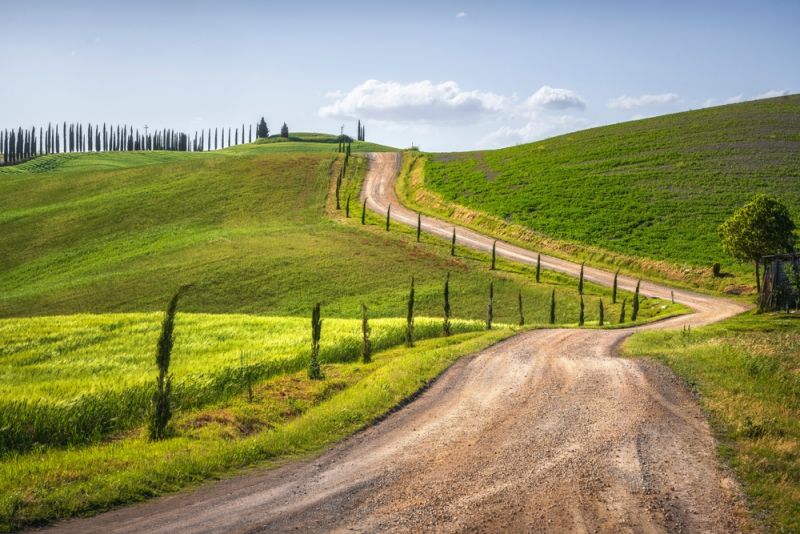
From Piacenza, the route turns south toward Tuscany, climbing out of the plain and into the rolling hills. This is the most beautiful section of the Italian route; gentle hills, cypress trees, small villages built on hilltops, the landscape that inspired Renaissance painters. You pass through San Gimignano, the medieval town of towers; Monteriggioni, a walled village that Dante referenced in the Divine Comedy; and eventually Siena, one of Italy’s greatest medieval cities.
From Siena, the final stretch descends toward Rome, passing through Val d’Orcia with its famous cypress-lined roads, the thermal springs of Vignoni, and the smaller Tuscan hill towns before descending into Lazio and approaching the capital.
The final days are anticlimactic by design. You leave the landscape behind and enter the sprawl of Rome’s outer suburbs, gradually making your way toward the city centre and St. Peter’s Basilica, where pilgrims traditionally end their journey.
Why It’s Better Than You Might Think
The Via Francigena is often dismissed as a less popular alternative to the Camino, as if it is second-rate by default. This misses several crucial points.
First, the route is far less crowded. If you walk the Camino de Santiago, you will encounter thousands of other pilgrims, stay in crowded albergues, eat in pilgrim restaurants, and experience a phenomenon that has become almost commercialised. The Via Francigena remains quiet. You can still find stretches where you walk for hours without encountering another soul. The infrastructure exists, but it has not been overtaken by tourism.
Second, the historical and architectural richness is arguably greater. The Camino passes through beautiful landscapes and historic towns, but the Via Francigena passes through the heartland of medieval European civilisation. You walk through regions where the Renaissance was born, where cathedrals represent the peak of Gothic architecture, where every small town has a history extending back to Rome itself.
Third, and perhaps most significantly, the destination changes the meaning of the journey. On the Camino, the end is another cathedral, albeit a spiritually significant one. On the Via Francigena, the end is Rome itself; the political, spiritual and cultural centre of Western Christianity for two millennia. Standing in St. Peter’s Square after weeks of walking carries a different weight than arriving at Santiago de Compostela.
The Practical Reality
Modern pilgrims walking the Via Francigena should expect:
Duration: From 4 to 8 weeks depending on where you start and your pace. Most people who do the full route from Canterbury take 8 to 10 weeks. Many do segments; walking just the Italian portion takes 4 to 6 weeks.
Difficulty: Moderate overall, with significant challenges in the Alps at the beginning and some steep climbs in Tuscany. The Po Valley section is flat and easy. It is less demanding than some parts of the Camino.
Infrastructure: Less developed than the Camino but improving yearly. Hostels, pilgrim accommodations and restaurants catering to walkers exist in most towns. You should book ahead, especially in peak season (May-June and September).
Season: Best walked from May to October. Winter is possible but challenging in the Alps. July and August are hot in the Po Valley and Tuscany.
Cost: Budget 30 to 50 euros per day for accommodation, food and other expenses if you are staying in basic pilgrim hostels and cooking some meals. Costs are lower in northern Italy and higher as you approach Rome.
The Credencial: You can obtain a pilgrim credential (credenziale) from the Opera Francigena or from churches along the route. Getting stamps in towns allows you to obtain a certificate of completion (certificato) upon arrival in Rome. This is less institutionalised than the Camino but the tradition is growing.
Why People Do It
The reasons pilgrims walk the Via Francigena vary. Some are explicitly religious; Catholics seeking spiritual renewal, a relationship with the Church renewed through physical effort. Others are secular; looking for a break from modern life, time to think, a challenge, a way to understand their place in European history.
What they report in common is this: the walk changes you. Not always in the ways you expect. Some find faith. Others lose it, or transform it. Many simply discover that they are capable of more than they thought, that their bodies can carry them for weeks, that they can befriend strangers from across Europe, that stopping your life for two months to walk across a continent is not impossible.
Getting There
The easiest starting point for most people is one of the Alpine passes. You can fly to Geneva (near the Great St. Bernard Pass) or to Turin (near Mont Cenis) and be on the route within hours. From Rome, regular flights connect to every major European city, making the Via Francigena far more accessible for modern travellers than the Camino de Santiago.
If you walk the Italian portion only, you can fly into Turin or Milan and reach the Alpine starting point via train. From Rome, any international airport serves the end point.
The Bottom Line
The Via Francigena is not as famous as the Camino de Santiago. It never will be; the Spanish route has become a global phenomenon, part of popular culture, the subject of books and films. But in its relative obscurity lies its greatest gift: it remains what the Camino has largely ceased to be; a genuine pilgrimage, a personal journey in a landscape of medieval Christianity, a chance to walk the same stones that kings, popes and ordinary people walked for a thousand years.
If you want crowds, infrastructure, and a proven experience, walk the Camino. If you want solitude, history, beauty, and to end your journey in the heart of Rome, walk the Via Francigena. The choice determines not just the path you walk, but the person you become by the time you arrive.
