

From the Mountains of the First World War to a Bronze Statue in Villa Borghese, the Mule Has Earned Its Place in Italian History
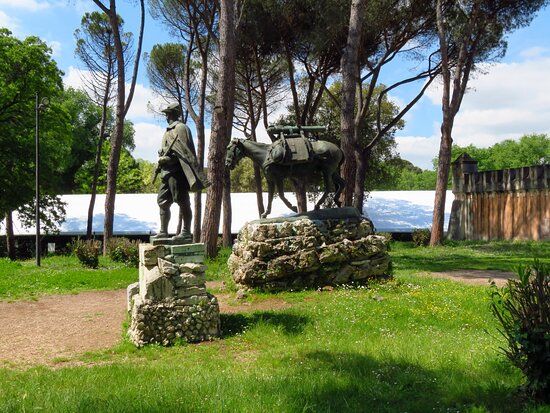
There is a small bronze mule standing in Villa Borghese, just in front of the Fortezzuola on Viale Pietro Canonica, that most visitors walk past without stopping. Those who do stop tend to feel something unexpected. The animal is rendered with quiet dignity, ears slightly forward, body compact and sturdy, entirely still. There is no drama in the pose. That is rather the point.
The statue was created in 1937 by sculptor Pietro Canonica, who lived in the Fortezzuola itself, and donated to the City of Rome in 1940. It depicts a specific animal: Scudela, a mule who served with an Alpini mountain artillery battery during the First World War. Every day for years, Scudela carried his cannon along the harsh mountain paths of the Alps, through snow and under enemy fire, inseparable from his Alpine soldier handler.
One morning, during a fierce engagement, the battery was forced to retreat and Scudela and his handler were listed as missing. By nightfall the mule had found his way back to the remnants of the unit. He returned alone. Of his companion, only the hat with the black feather remained.
Scudela was awarded the Gold Medal for Military Valour at the end of the war. The inscription on the base carries the battle cry of the Aosta Brigade: “Ca Custa Lon Ca La Custa, Viva L’Austa” — whatever it costs, long live the Aosta. Since 1957, an Alpine soldier has stood beside him, sculpted by the same hand, so that Scudela is no longer alone.
The Mule Is Not a Donkey
Before going further, a clarification that Italians instinctively understand but that is worth stating: the mule (mulo) and the donkey (asino) are not the same animal, and the distinction matters.
A mule is the hybrid offspring of a male donkey and a female horse. Mules are larger than donkeys and typically larger than the donkey parent, combining the strength and size of the horse with the endurance, surefootedness, and resilience of the donkey. The donkey is a species in its own right, domesticated for thousands of years. The mule is a deliberate cross, bred for a specific purpose: to produce an animal that can do what neither parent can do alone.
Male mules are almost always sterile due to their odd number of chromosomes (63, compared to 64 in horses and 62 in donkeys). This means every mule must be bred anew, which made them valuable and carefully managed animals throughout history.
The practical differences are significant. The mule is stronger than the donkey, more resistant to disease than the horse, calmer in difficult terrain than either, and able to carry heavy loads over long distances without the constitution of a horse. What looks like stubbornness is actually considered a form of self-preservation: a mule will refuse a task it judges physically dangerous, which is not stupidity but a kind of intelligence that made it uniquely suited to mountain warfare.
The Mule and Italy’s Mountains
Italy is a country built around difficulty. Its spine is the Apennines. Its northern frontier is the Alps. For most of its agricultural and military history, the territory that mattered most was the territory hardest to reach, and the animal best suited to reaching it was the mule.
During the First World War, the mule was considered precious for the transportation of weapons, provisions, and equipment along the mountain front. During the Second World War, the number of mules with the Italian Alpine troops was estimated at approximately 520,000. No other number quite captures the scale of the animal’s contribution to Italian military history.
First-class mules were the largest and most robust and were used by the artillery for transporting weapons and ammunition, particularly the 120mm mortar, which disassembles into three parts: the base plate, the mount, and the barrel. This mortar required at least three Alpine soldiers to carry manually. Second and third-class mules were smaller and used by the Alpine infantry for tents, ammunition, and supplies.
The bond between the Alpine soldier and his mule was not merely operational. In each company, every mule was assigned a specific soldier, called a conducente, who was responsible for the animal throughout his military service. When soldiers completed their service, the rules of care were passed down to the next conscripts. This transfer of knowledge, from one generation of soldiers to the next, through the shared responsibility of an animal, created a relationship that shaped the culture of the Alpini as much as any battle.
The last mules used by the Alpini were sold at auction in 1993 following the corps’ reorganisation. The last of those mules, named Iroso, died of natural causes on 29 April 2019, aged 40. He had been purchased at auction by a former Alpine soldier, who had cared for him until his death.
Agriculture, Transhumance and the Land
Beyond the military, the mule shaped the Italian countryside. In the agricultural South, where the terrain was too steep and the soil too poor for large horses, the mule was the engine of the farm. It ploughed, it hauled, it carried the harvest from fields that no wheeled vehicle could reach.
Each year in Italy, a centuries-old practice known as transhumance takes place, where donkeys and mules help shepherds carry newborn lambs down mountains to grazing areas in the plains. This tradition, dating back over a thousand years, was recognised by UNESCO in 2019 as an Intangible Cultural Heritage of Humanity.
In Italy historically, mules made up half of the equine population. The papal court’s own etiquette specified mules for the Pope’s carriage, and Italian nobles adjusted their practices accordingly, riding mules rather than horses. In this sense the mule was not merely a working animal but a marker of a certain kind of Italian pragmatism: choosing the animal best suited to the actual conditions of the land, regardless of the prestige attached to the horse.
Is the Mule Loved?
The mule occupies a curious place in Italian affection. It does not have the romance of the horse, the Biblical resonance of the donkey, or the domesticity of the dog. It is not a pet. It is not a symbol. It is a worker, and Italy has always had a complicated relationship with things that work without complaint and ask for nothing in return.
And yet the statue in Villa Borghese exists. The Alpini of Rome gather before it every October to lay a wreath. The Gold Medal for Military Valour was awarded to a mule. The last surviving military mule died attended by the man who had bought him at auction specifically to give him a dignified retirement. These are not the gestures of a society indifferent to an animal.
What Italy feels for the mule is perhaps something more specific than love: it is recognition. The recognition of an animal that did what was asked of it, in the worst conditions imaginable, without glory, without complaint, and often without returning. The sculptor Canonica called his monument “L’Umile Eroe,” the humble hero. In a country that has always had an uneasy relationship with the word humble, that is a title worth examining.
The mule earned it.
ph: Tripadvisor – Claudio D.
