

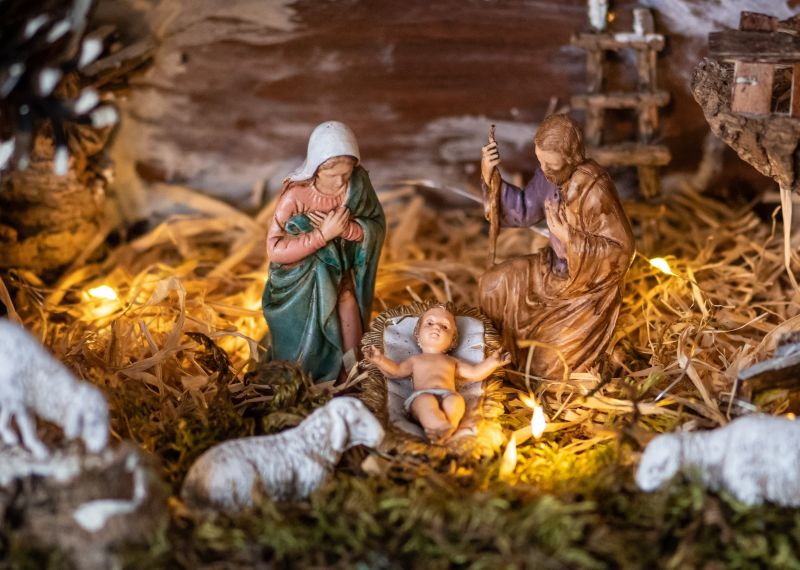
Led by Italy and joined by Spain and Paraguay, a multinational candidacy aims to inscribe the presepe on UNESCO’s Representative List of Intangible Cultural Heritage.
Italy has submitted a candidacy to UNESCO seeking the inscription of the nativity crib – known in Italian as the presepe or presepio – on the Representative List of the Intangible Cultural Heritage of Humanity.
The proposal, forwarded to the UNESCO Secretariat in Paris as part of the 2026 cycle, was approved on Thursday by the governing council of the Italian National Commission for UNESCO (CNIU), acting on the proposal of the culture ministry.
The candidacy is a multinational one, submitted under Italy’s leadership and with the participation of Spain and Paraguay.
It draws particular attention to the contributions of the Associazione Italiana Amici del Presepio, as well as the symbolic sites of Greccio and Assisi, which are inseparable from the tradition’s origins.
Tradition rooted in Saint Francis of Assisi
The nativity crib is one of the most enduring expressions of Catholic religious and popular culture.
Its origins are conventionally traced to Saint Francis of Assisi, who in 1223 staged the first living representation of the Nativity of Jesus Christ in the town of Greccio, in Umbria, using a manger, farm animals and local participants to bring the biblical scene to life.
From that theatrical act of devotion, a broader tradition of representing the Nativity through figures, models and miniature scenes took root across the Italian peninsula and, in time, throughout the Catholic world.
The crib candidacy carries particular resonance in 2026, the year that marks the 800th anniversary of the death of St Francis of Assisi – a coincidence of timing that Italy’s cultural authorities have emphasised as lending the submission an additional dimension of historical significance.
Over the centuries, the tradition diversified and flourished in distinct regional forms. The Neapolitan presepe, which reached its artistic zenith in the 18th century under the patronage of the Bourbon royal family, became a vehicle not merely for religious devotion but for vivid portraiture of urban life.
Craftsmen worked in terracotta, wood, papier-mâché and precious fabrics to create scenes of extraordinary intricacy that are now displayed in museums. Other schools of crib-making developed in Sicily, in Puglia and across central Italy, each with its own aesthetic conventions and materials.
Cultural identifier and social bond
Speaking in support of the submission, Italy’s culture minister Alessandro Giuli described the tradition of the presepe as a defining element of Italian cultural identity, a social bond for Italian communities and an outstanding expression of traditional artistic craftsmanship.
The CNIU’s governing council, in approving the candidacy, also expressed a preference for the multinational route – the submission led by Italy together with Spain and Paraguay – over a purely national one.
This reflects UNESCO’s encouragement of cross-border applications for traditions that transcend the boundaries of a single state, and acknowledges that the presepe has deep roots in the cultural life of other Catholic nations.
The candidacy’s dossier underlines that the tradition embodies a dialogue of intercultural values connected to the promotion of ideals of peace and fraternity among peoples – an emphasis that aligns with UNESCO’s broader mission and strengthens the case for inclusion in the Representative List.
Italy’s wider programme of UNESCO bids for 2026
The presepe bid is not Italy’s only submission to UNESCO in the current cycle.
Alongside it, the CNIU also approved a national candidacy for the Representative List concerning the ritual of resting the grapes of the Valpolicella – “Il rito della messa a riposo delle uve della Valpolicella” – a tradition that encompasses a body of knowledge attested since the early Middle Ages, relating to the distinctive grape-drying techniques practised in the Valpolicella region of the Veneto.
This practice, which gives rise to wines such as Amarone and Recioto, is considered a testimony to the close relationship between human communities and the natural environment, maintained in harmony with seasonal rhythms.
Italy is also participating in a multinational candidacy for the Register of Good Safeguarding Practices, concerning alpine food heritage – “Il patrimonio alimentare alpino: programmi culturali di salvaguardia promossi dalle comunità” – coordinated by Switzerland and also involving France and Slovenia.
This submission addresses the ensemble of practices, traditions and competences linked to the protection of food heritage as a vehicle of cultural identity, social cohesion and sustainable development for the countries bordering the Alpine arc.
In addition, the CNIU has approved an extension of the existing multinational candidacy on traditional irrigation – to which Italy has participated since 2023 – to include France and Greece.
Italy’s growing UNESCO Intangible Heritage portfolio
The 2026 submissions build upon Italy’s considerable existing portfolio of UNESCO intangible cultural heritage. The country achieved a landmark recognition at the end of 2025, when Italian cuisine was inscribed on the Representative List following a three-year campaign – the first national cuisine in the world to receive such recognition in its entirety. Prior inscriptions have included the opera singer’s art, truffle hunting and extraction, the Neapolitan pizza-maker’s craft, and, most recently, the tradition of manual bell ringing.
The submitted 2026 dossiers now await evaluation by UNESCO’s international bodies, which will assess whether the presepe and the other proposed elements meet the criteria for inscription.
A decision is expected in the course of the standard annual review cycle.
Photo Shutterstock.com
