

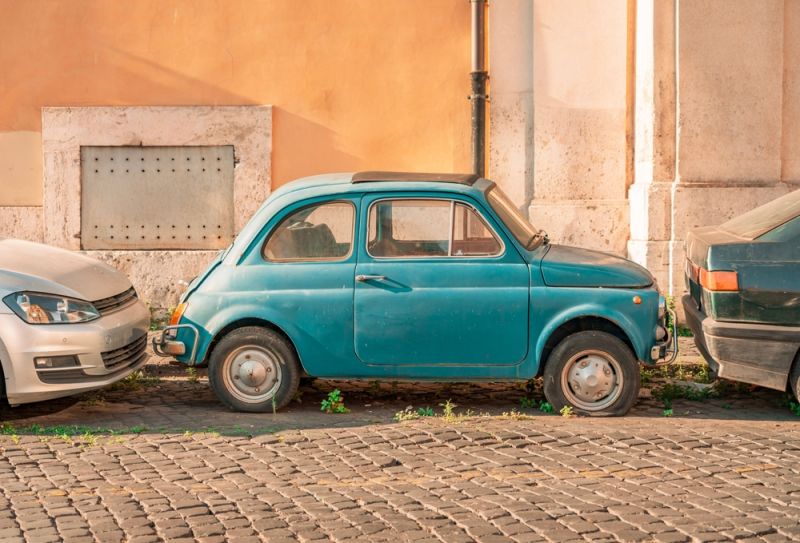
In Rome, a Scratch Is Not an Insult. It Is a Conversation. Bumpers, Blue Lines and Botta di Dietro: The Unwritten Rules of Parking in Rome
There is a phrase that every Roman driver knows and that no driving instructor will ever teach you. Botta davanti, botta di dietro. A bump in front, a bump behind. It is not a lament. It is a parking strategy.
To understand Roman car culture, you need to abandon several assumptions you may have brought with you from wherever you learned to drive. The assumption that parking spaces have fixed boundaries. The assumption that bumpers are primarily decorative. The assumption that the distance between your car and the next one is something you should be able to measure in centimetres rather than estimate by feel and faith. In Rome, parking is a contact sport, and everyone who plays it has made a tacit agreement not to take it personally.
How It Works
The system operates on a principle of collective negotiation. When a Roman driver needs to extract their car from a tight space, they do not wait for the cars in front and behind to move. They use them. A gentle push forward, a gentle push back, the car rocks itself free, and the driver departs without guilt or ceremony. The cars left behind are perhaps a few centimetres closer together than they were before. This is understood. When those drivers return and need to leave, they will do the same.
The cars themselves are the physical record of this culture. Walk through any Roman neighbourhood and you will see it written in metal: the abbreviated front bumpers, the paint that has been applied not once but several times over the original colour, the numberplates that have been bent back into something approximately flat. These are not signs of carelessness. They are signs of use. A Roman car without marks is a car that either lives in a garage or has not been in Rome very long.
The Geometry of the Roman Street
Rome was not designed for cars. It was designed for feet, for horses, for the occasional chariot, and then for centuries of incremental urban accumulation that produced streets of breathtaking narrowness and corners of geometric ambition that no traffic engineer would sanction today. The result is a city in which the car is simultaneously ubiquitous and slightly absurd, a machine designed for open roads attempting to negotiate alleys that were tight when Julius Caesar walked through them.
The Centro Storico presents the most extreme version of this problem. Streets like Via del Governo Vecchio or the lanes behind Campo de’ Fiori were built for a pre-automotive civilisation and have been reluctantly accommodating cars ever since. Parking here is not a matter of finding a space. It is a matter of creating one where none officially exists: on pavements, alongside bins, in the sliver of space between a doorway and a bollard, occasionally on what someone else might call a pedestrian zone but a Roman driver has learned to regard as a possibility.
The ZTL, the Zona a Traffico Limitato that restricts access to much of the historic centre during certain hours, has theoretically reduced this pressure. In practice it has concentrated it: at the ZTL boundary, where the restrictions end, a geography of creative parking has evolved that requires daily negotiation and occasional philosophical acceptance.
The Motorino Question
Rome’s relationship with the motorino, the scooter, is inseparable from its relationship with the car. The motorino exists partly as an escape route from the car’s spatial problem, weaving through traffic that has stopped entirely, parking in the margins that no four-wheeled vehicle could occupy. On a Rome rush hour, the space between two lines of stationary cars fills steadily with scooters moving forward in a column of their own, governed by rules that are mostly improvised and largely honoured.
The relationship between car drivers and motorino riders is one of mutual wariness and occasional respect. The car driver knows the scooter will appear from somewhere unexpected. The scooter rider knows the car door may open without warning. This knowledge does not prevent either thing from happening. It simply means that when it does, nobody is entirely surprised.
The Parking Attendant Problem
On major streets and in the newer residential zones, Rome operates a paid parking system managed by attendants and marked by blue lines on the road. The theory is that you pay for your time, display your ticket, and return to your car before it expires. The practice is more varied. The tickets are displayed or not displayed. The attendants pass or do not pass. The fine is issued or, more often, is not issued. The system functions at a level of approximate compliance that seems to satisfy nobody completely and yet somehow continues to function.
The parcheggiatore abusivo, the unofficial parking attendant who appears without invitation to wave you into a space and then expects payment for the service, is a figure that Rome has been trying to eliminate for decades and has not yet managed to eliminate. He occupies a particular position in the Roman urban ecosystem: providing a service that nobody asked for, in exchange for payment that is technically optional and practically not, in a city that has never fully resolved its relationship with the informal economy.
What It Says About Rome
Car culture in Rome is not separable from the broader Roman attitude toward rules, which is that they describe an ideal rather than a requirement. The Italian highway code is, on paper, one of the more comprehensive in Europe. In Rome, it is applied with a creativity that its authors did not intend.
This is not unique to Rome among Italian cities, but Rome does it with a particular confidence. The Roman driver who parks on a corner, or across a dropped kerb, or in the middle of what was once a cycle lane, does so not with the furtive guilt of someone who knows they are breaking a rule but with the calm authority of someone who has assessed the situation and made a decision. The horn, when used, is not an expression of anger but of communication: I am here, I am moving, please adjust accordingly.
There is something almost philosophical about the whole enterprise. Rome is a city that has survived the fall of empires, the sack of barbarians, the Black Death, and several decades of municipal mismanagement. In this context, the question of where to put the car acquires a certain perspective. You park where you can. You leave a little space for the person behind you to breathe. You accept that when you come back your car may have been touched, moved, or lightly redecorated by the city itself.
Botta davanti, botta di dietro. The city moves. You move with it.
